Most internet users have seen the same handful of stock photos hundreds of times. The woman laughing at a salad. The diverse team high-fiving around a laptop. The handshake photographed from the exact same angle, over and over, on hundreds of unrelated websites. Nobody registers these images as fake, exactly. They register them as generic, and generic is its own quiet problem when a visitor is trying to decide whether a business is real, local, and worth trusting.
Key Takeaways
- Visitors have seen the most common stock photos so often that the images register as generic rather than specific, even without consciously placing where they’ve seen them before.
- Generic imagery does not actively signal dishonesty, but it fails to do the work that a photo is supposed to do: prove the business behind it is real and specific.
- Research into what actually builds trust on local business websites consistently ranks authentic, owner or team photography above polished stock imagery.
- The gap matters most on pages where trust is the entire point, About pages, team pages, and anywhere a visitor is deciding whether to make contact.
- Replacing every stock photo isn’t necessary. A handful of real photos in the highest-trust spots on a site usually delivers most of the benefit.
The instinct to use stock photography usually comes from a good place, a business wants to look professional and doesn’t have polished photos of its own. The result, though, often reads as the opposite of professional: interchangeable.
Why “Generic” Reads Differently to “Professional”
A stock photo is not dishonest. Nobody looks at a smiling team photo on a plumbing company’s website and assumes the business is lying about existing. What actually happens is subtler: the photo fails to do the one job it was put there to do, which is to make the business feel specific, local, and real rather than interchangeable with every other business using the same image library. That gap between what an image is meant to prove and what it actually communicates is where the real cost sits.
Research from BrightLocal into what actually builds trust on local business websites found that genuine photos of the business owner inspired far more consumer trust than generic stock imagery, and that no images at all sometimes outperformed the wrong kind of image. The finding is a useful correction to the instinct that any photo is better than no photo. A visitor scanning a page is not grading it on polish alone. They are looking for evidence that a real person and a real business sit behind the page.
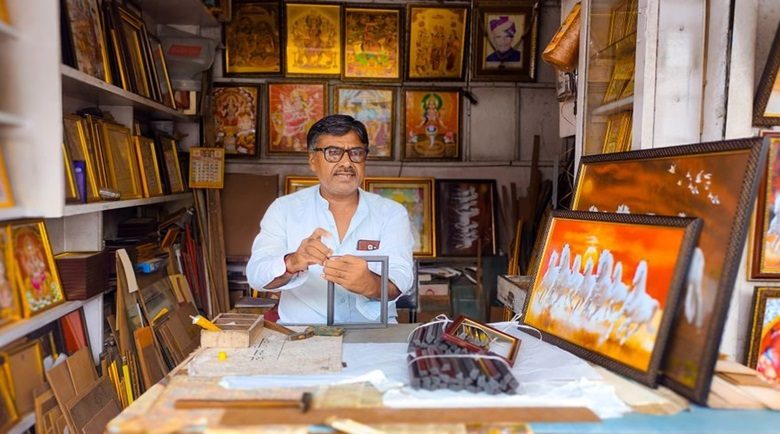
A small business owner in their own shop being photographed
Where the Gap Actually Costs Something
Not every page carries the same weight of trust. A stock image on a decorative banner rarely matters much. The pages where imagery genuinely affects a visitor’s decision are the ones where trust is the entire point: About pages, team pages, testimonials, anywhere a visitor is actively weighing up whether to pick up the phone or fill in a form.
The Stanford Web Credibility Project’s long-running guidelines on what makes a website believable point specifically to this kind of evidence, visible proof of the real people and real operation behind a page, as one of the strongest levers a business has over how trustworthy it appears. Generic stock photography on exactly these pages undercuts the one job they are meant to do, because a visitor deciding whether to trust a business is, in that moment, actively looking for proof it is not just a template.
A stock photo doesn’t make a business look untrustworthy. It just fails to prove the business is real, on the exact pages where a visitor is looking for that proof.
Why the Same Photos Keep Showing Up
Part of the problem is structural, not a failure of judgement by any individual business. Free and low-cost stock libraries are used by enormous numbers of websites, so the most convenient, well-lit, professionally shot options are also the most repeated. A business picking the best-looking photo from a popular library is, by definition, more likely to pick one thousands of other sites have also picked.
A marketing agency writing on the topic put it plainly: overused stock photography creates a sense of detachment precisely because visitors have, whether they consciously register it or not, seen the image somewhere else before. That recognition, even vague and unplaced, is enough to weaken the sense that the page in front of them is specific to this one business, and it happens without the visitor ever consciously working out why the page feels slightly off.
Two people reviewing photography on a laptop screen in an office
Fixing It Without a Full Photoshoot
The fix does not require replacing every image on a site. Most of the trust benefit comes from swapping out stock photography in the highest-visibility, highest-trust spots, the team photo, the About page hero image, the face attached to testimonials, rather than every decorative image throughout. A single genuine photo, even taken on a phone with reasonable lighting, tends to outperform a polished stock alternative in exactly the places a visitor is deciding whether to trust the business. It is a smaller job than most business owners assume, and usually a quicker one than arranging a full photoshoot around a busy working week.
For businesses unsure where to start or how to prioritise which images matter most, a web design review can identify the specific pages where swapping stock imagery for real photography would make the biggest difference to how a visitor perceives the business. You can read more here if a site-wide photo audit sounds like the more useful next step than guessing which images are actually doing the business any harm.
A photographer taking a portrait photo of a business owner in a studio
Frequently Asked Questions
Do stock photos actually make a website look untrustworthy?
Not directly. Stock photos don’t signal dishonesty, but they fail to prove a business is real and specific, which matters most on pages where a visitor is actively deciding whether to trust the business, such as About and team pages.
Which pages benefit most from replacing stock photography?
About pages, team pages, and testimonials benefit the most, because these are the pages where a visitor is specifically looking for evidence the business behind the site is genuine, not a template.
Do I need a professional photoshoot to fix this?
No. A handful of genuine photos, even taken on a phone with decent lighting, in the highest-trust spots on a site usually delivers most of the benefit, without needing to replace every image across the whole website.
Why do the same stock photos show up on so many websites?
Popular free and low-cost stock libraries are used by huge numbers of sites, so the most polished, convenient images end up repeated across thousands of unrelated businesses, which is part of why they read as generic even when nobody can place exactly where they’ve seen them before.
Is it ever fine to use stock photography on a business website?
Yes, particularly for decorative or background imagery where trust isn’t the main job the image is doing. The gap matters most on pages where a visitor is weighing up whether to make contact, not on every image throughout a site.
Sources
- Images Inspire Trust in Local Businesses: BrightLocal
- Web Credibility Project Guidelines: Stanford University
- Do Customers Distrust Websites With Stock Photos?: GroupM7